
Technical Background and Product Positioning
• Evolution of technical standards
Since the standard freeze in 2016, Wi Fi HaLow (IEEE 802.11ah) has gone through a period of technical validation and pilot deployment, and entered the Asia Pacific commercial acceleration period in 2024, becoming one of the key technologies in the field of IoT communication.
• Advantages of Sub-1GHz frequency band technology
The Sub-1GHz frequency band, compared to traditional 2.4GHz Wi Fi, has longer transmission distance, stronger penetration capability, and lower power consumption characteristics, making it suitable for large-scale IoT deployment.
• Market positioning and application value
Filling the technological gap of insufficient coverage of traditional Wi Fi and excess performance of cellular networks, it has become an ideal choice for scenarios such as smart meter reading, industrial sensing, and smart cities.
In order to meet market demand and keep up with technological development, Acrel has launched Wi-Fi HaLow communication gateway, AWT100-AP/WHF
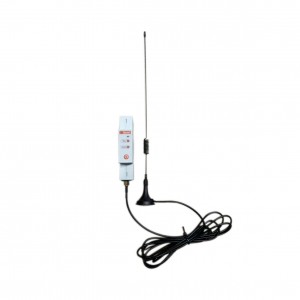
Wireless Communication
• IEEE 802.11ah Standard
The AWT100-AP/WFH is a Wi-Fi data transmission module compliant with the IEEE 802.11ah standard. Operating in the sub-1GHz band, it offers longer transmission ranges and stronger penetration capabilities compared to traditional 2.4GHz Wi-Fi. European Version (EU): Suitable for regions such as Europe and Asia, operating in the 859–894 MHz band. North American Version (NA): Suitable for North America, operating in the 902–928 MHz band.
• Communication range
In industrial or urban environments, the recommended communication range is 200 meters. Wall penetration on the same floor (60 meters through 5 walls, with stable communication when the antenna is unobstructed); vertical floor penetration (recommended ≤ 3 floors). In complex industrial environments, it is recommended to limit the communication distance to 60 meters horizontally or within 3 floors vertically. Additionally, for longer distances, ensure that the antenna is positioned in a relatively open area with no significant obstructions to guarantee the real-time performance and reliability of Modbus communication.
Security Encryption System and Data Protection Policies
• WPA2-PSK Authentication
By utilizing the Wi-Fi Protected Access II pre-shared key mode, it provides a robust authentication mechanism that effectively safeguards against the risk of unauthorized access.
• AES End-to-End Encryption
Advanced encryption standards ensure the confidentiality and integrity of data transmission, and resist threats such as data eavesdropping and man in the middle attacks.
Dual-Mode Architecture and Automatic Network Configuration Mechanism
• Dual-Mode Architecture
Supports AP mode (Access Point) and STA mode (Station), enabling point-to-point or point-to-multipoint wireless data transmission through network configuration, and flexibly adapting to the requirements of different network architectures. Press and hold the front button for 3 seconds to switch communication modes.
• Automatic Network Configuration Mechanism
Briefly press the buttons on the AP and STA modules to enter pairing mode. The STA indicator will flash rapidly to indicate that it is searching for a pairing partner. When the red light on the STA module remains steady, pairing is successful. Briefly press the button on the AP module to exit pairing mode, enabling one-click smart networking.
Architecture of Smart Grid and Wireless Meter Reading System
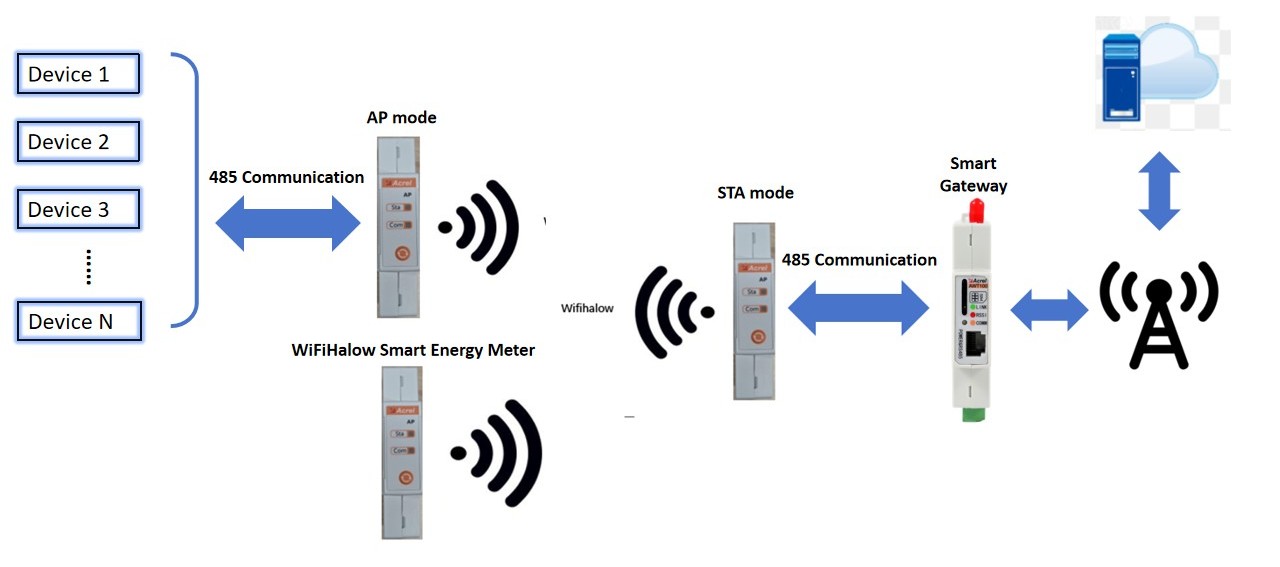
The system employs a four-layer architecture comprising a gateway, an access point (AP), a terminal (STA) and a meter. Downlink data flows from the gateway through the AWT100 access point (AP), the WFH wireless channel and the AWT100 terminal (STA) to the meter; uplink data flows in the opposite direction. This enables seamless conversion of the MODBUS-RTU protocol and end-to-end wireless data transmission.
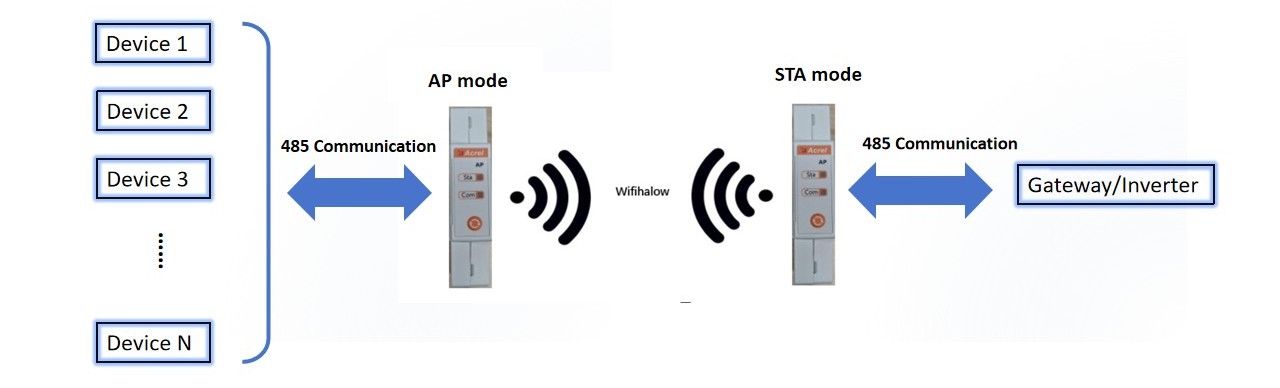
Schematic Diagram of Data Upload to IoT Platform
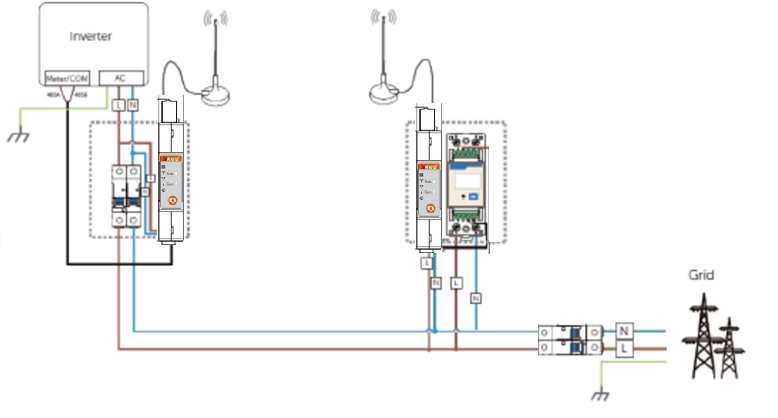
Schematic Diagram of Anti-Backflow Application
Building Automation and Industrial IoT Deployment Solutions
• Building Automation Applications
Applied to HVAC control, intelligent lighting, and security monitoring, utilizing WiFi HaLow's strong penetration capability to solve the signal shielding problem of reinforced concrete structures.
• Power Load Monitoring Solution
Realize distribution monitoring, energy consumption management, and load control, and support refined energy management decisions through real-time data collection.
• Industrial Internet of Things Deployment
Meet the requirements of equipment status monitoring, remote control, and automated data collection, ensuring the reliability, real-time performance, and security of communication in industrial sites.
• Household Solar and PV Anti-Backflow
Meet the construction requirements for wireless installation and achieve wireless communication between the inverter and the electricity meter.
Post time: May-22-2026